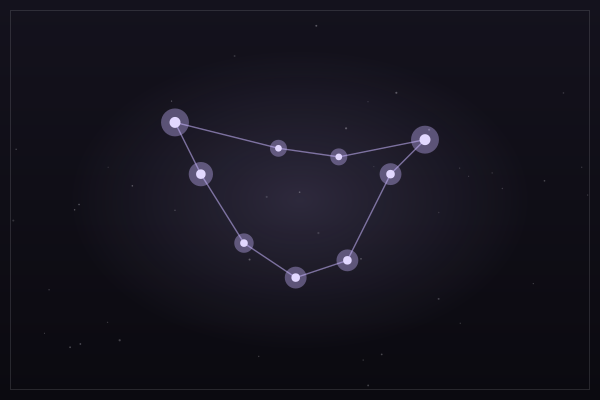
January is the one month where a printed zodiac chart cannot settle a dog’s sign from the date alone. The 1st through the 18th is Capricorn and the 21st onward is Aquarius, every year. The 19th and the 20th are a different matter: between 2010 and 2027 the Sun reached Aquarius on each of those days in exactly nine years, so a dog born on either one needs its birth year, and usually its birth hour, before anyone can name a sign.
Dog born in January at a glance
Signs: Capricorn through January 18 in every year · Aquarius from January 21 in every year · January 19 and 20 change with the year (printed charts hand the 19th to Capricorn and the 20th to Aquarius)
Measured switch, US Eastern time, 2010–2027: January 19 in 9 years · January 20 in 9 years · the only boundary in the table split exactly in half · crossing times by year
Dog birth calendar: among 2,469 litters registered with the Swedish Kennel Club, winter was the top mating season. January is a month puppies are conceived in more than born in
Cusp? January 19–20 is what people call the Capricorn–Aquarius cusp; a dog born there still has one sun sign, fixed by that year’s crossing minute
Only know the month? About 3 in 5 odds of Capricorn, assuming births fall evenly across the 31 days
No birth record, just a best guess on a card? The free quiz reads your dog’s habits instead of a date →
Capricorn first, then Aquarius: January’s two dogs Earth through the 18th, air from the 21st
Capricorn holds the opening of the month. Astrology reads it as the steady, rank-aware dog that learns the household schedule and then enforces it, slow to warm to strangers and hard to shake once attached. The Capricorn dog profile tests that picture against breed data and owner reports, and the dog zodiac guide gives the one-paragraph version.
From the 21st, every year, the month belongs to Aquarius, the fixed air sign. Its dog is the one with a private logic: affectionate on its own schedule, bored by repetition, happiest with a problem to work on. The Aquarius dog profile has the full read.
| January | Capricorn | Aquarius |
|---|---|---|
| Element and mode | Earth, Cardinal | Air, Fixed |
| Classical ruler | Saturn | Saturn, with Uranus added in modern practice |
| Owner shorthand | steady, scheduled, slow to trust, loyal for life | independent, inventive, affectionate on its own terms |
| Days in January | January 1–18, every year January 19–20, depends on the year | January 21–31, every year January 19–20, depends on the year |
| Conceived around | late October to mid-November | mid-to-late November |
January, when most matings happen and few puppies arrive Dog birth seasonality, from registry records
Nobody counts dog birthdays. There is no census of puppies, only kennel-club registries and the breeding records researchers pull from them, so every seasonal claim about dog births comes with a qualifier: it describes registered, pedigree dogs in one country and one span of years, not dogs in general.
The qualifier matters because dogs are not seasonal breeders the way sheep or cats are. VCA Animal Hospitals puts it plainly: “Most dogs come into heat twice per year, although the interval can vary between breeds and from dog to dog,” and “There is no set breeding season for domesticated dogs.” Two cycles a year, timed by the individual dog, means litters can land in any month.
Within that, registries do show a tilt, and January sits on the mating side of it rather than the whelping side. Linde-Forsberg and Wikström’s 2008 study of 2,469 litters from 13 breeds registered with the Swedish Kennel Club found that “Over all, most matings occurred during winter, with spring in second place,” with winter defined as December through February. Summer and autumn showed no difference from each other. Breed by breed, the frequency of matings “varied significantly between seasons in 7 of the breeds, but in different ways”: German Shepherds, Labrador Retrievers, Norwegian Elkhounds and Irish Soft Coated Wheaten Terriers mated most in winter, Beagles in spring, Basenjis in autumn.
Turn that around and January looks different from the inside. A puppy born in January was conceived around November, in the autumn stretch where the Swedish data shows no mating surge at all. The matings happening in January itself will become late-winter and spring litters. So among those registered dogs, January is more a month of conception than of birth: the kennels are busy, the whelping boxes mostly are not yet.
A single-breed record points the same way. A retrospective study of the Drever, a Swedish hound, covered 2,717 litters registered with the Swedish Kennel Club between 1995 and 2006 plus one private kennel’s 285 matings and 224 whelpings, and found both matings and whelpings clustered in winter and spring, with the largest litters arriving in spring. A January Drever puppy sits inside that cluster; a January Labrador puppy, by the 13-breed data, is a step ahead of it. Either way, the pattern is a tilt in registered litters, not a rule for the dog on your couch.
Paperwork says January but the dog says otherwise? The free quiz sorts by behavior, no birthday required →
Nine years and nine: the leap-year rhythm behind January 19 and 20 The only even split in the table
Printed charts give January 19 to Capricorn and start Aquarius on the 20th. Our open table of 216 sign changes for 2010–2027, computed with the Swiss Ephemeris and kept in US Eastern time, says the Sun reached Aquarius on January 19 in 2010, 2013, 2014, 2017, 2018, 2021, 2022, 2025 and 2026, and on January 20 in 2011, 2012, 2015, 2016, 2019, 2020, 2023, 2024 and 2027. Nine years each way. Every other sign boundary in the table has a majority day; this is the only one that splits exactly in half.
The split is not random. A calendar year runs about six hours short of the Sun’s circuit, so each crossing lands roughly six hours later than the year before, and every leap day drags it back by almost a full day. Follow one cycle: 11:09 am on January 20 in 2012, then 4:51 pm on January 19 in 2013, 10:51 pm on January 19 in 2014, 4:43 am on January 20 in 2015, 10:27 am on January 20 in 2016. Two years on the 19th, two on the 20th, repeat.
For a January dog born between 2010 and 2027 that gives a rule of thumb: in a leap year or the year before one, the printed chart’s January 20 held; in the two years after a leap year, Aquarius arrived on the 19th.
Settling a January 19 or 20 birthday: year, hour, time zone Every crossing, 2010–2027, US Eastern
Knowing the day is half the work, because the Sun crosses at a minute, not at midnight. Every January 19 crossing in the table came in the afternoon or evening, and every January 20 crossing came in the morning:
- January 19 — 2010 11:27 pm · 2013 4:51 pm · 2014 10:51 pm · 2017 4:23 pm · 2018 10:09 pm · 2021 3:39 pm · 2022 9:39 pm · 2025 3:00 pm · 2026 8:44 pm
- January 20 — 2011 5:18 am · 2012 11:09 am · 2015 4:43 am · 2016 10:27 am · 2019 3:59 am · 2020 9:54 am · 2023 3:29 am · 2024 9:07 am · 2027 2:29 am
Read it as three steps. First, the year picks the day from the lists above. Second, the hour: a puppy born before that year’s minute is a Capricorn, after it an Aquarius. A dog born at 2 pm on January 19, 2021 is a Capricorn, because the crossing that day came at 3:39 pm; a littermate delivered at 5 pm is an Aquarius. Third, the clock: these times are US Eastern. A birth at 1 pm Pacific on the same January 19, 2021 was 4 pm in the East, past the crossing, so that puppy is an Aquarius even though the local clock read early afternoon. All eighteen crossings sit inside one window of about twenty hours, from mid-afternoon on the 19th to late morning on the 20th; a birth outside that window on either day never changes sign by year.
Month and day go into the pet zodiac calculator; for the 19th and 20th it returns both names, and its Aquarius ingress list is where the year’s minute breaks the tie.
Only “January” on the paperwork? About 3 in 5 for Capricorn 61.4%, if births fall evenly
A breeder’s note or a shelter card often stops at the month. Even so, January narrows things: 18 of its days are Capricorn in every year, 11 are Aquarius in every year, and the 19th and 20th split by year and hour. Spread births evenly across the 31 days, weight the two swing days by each year’s crossing minute, average over 2010–2027, and a January dog with no known date comes out Capricorn 61.4% of the time, about 3 in 5.
Treat the number as arithmetic, not biology. The even spread is an assumption; no registry records enough dog birthdays to say how January litters actually fall across the month, and the Swedish data above suggests the month is thinner in whelpings than in matings anyway. It is a lean, not a verdict.
Estimated birthdays and gotcha days in a January file When the date is a guess, give it room
Many January dates were never witnessed. A shelter or rescue worked them out from teeth, weight and coat, and those estimates carry an error of weeks. VCA’s teething guide notes that “Puppies begin teething at around three weeks, and by approximately six weeks, all their deciduous teeth will have erupted,” and that the permanent teeth begin to come in at around 12 weeks; a puppy read from that clock as roughly eight weeks old on a March intake gets a January birthday, but a January estimate near the 1st or the 31st can slide into December or February, and one near the 19th or 20th can change sign outright. The age call belongs to the shelter and the veterinarian, and nothing on this page is veterinary advice. The May page walks through how far such an estimate can drift and what to do when its error band crosses a sign boundary.
When no estimate exists at all, many owners celebrate the gotcha day instead. Astrology has nothing to say about an adoption date, but the calendar does: a gotcha day that falls on January 19 or 20 inherits the same year-and-hour question as a birthday, and the lists above settle it the same way.
After the sun sign: what the January hour adds Moon, rising, and the keepsake
The same birth hour that decides a January 19 birthday is what astrology needs for the rising sign, and the full date gives the moon sign. A January dog whose owner has already dug up a time has, almost by accident, everything a complete chart asks for. The full Furscopes report draws all three layers together as a keepsake, and the sample report shows exactly what arrives before you order.
Two Capricorn littermates born an hour apart on January 10 share a sun sign and can still differ on the rising sign, which is the layer astrology uses to explain why one guards the door and the other sleeps through visitors.
Capricorn, Aquarius, or something the calendar missed?
Two minutes, a handful of questions about how your dog actually behaves, no birth date required: the free quiz names their cosmic type and shows how the two of you fit.
Reveal their star sign, freeKeep reading
- The December dog, a month earlier: Capricorn’s first days, which arrive on December 21 in 17 of 18 years, and the start of the winter mating season.
- The February dog, a month later: Aquarius gives way to Pisces on the 18th in most years, not the 19th the charts print.
- Half a year away, the July dog: Cancer and Leo, in the last month of the registered-birth peak.
- Same month, other species: the January cat, where the 19th and 20th split the same way and the season reads differently.
- The Capricorn dog profile, for the first eighteen days of the month.
- More birth months and sign profiles in the journal.