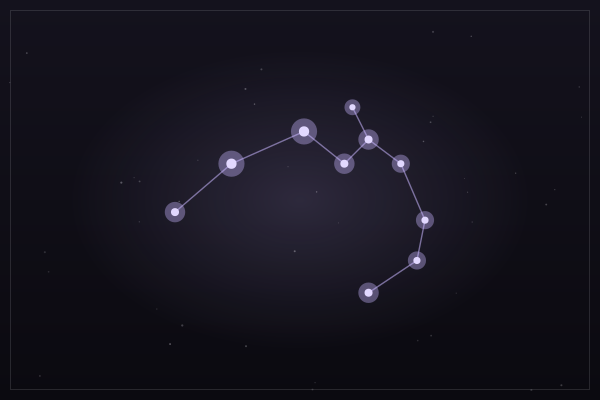
Most of February is settled before you look anything up. A dog born on any day from the 1st through the 17th is an Aquarius, and a dog born on the 20th or later is a Pisces, with no exceptions in any year from 2010 to 2027. Two days in the middle, February 18 and 19, change sign from one year to the next, and on those two days the birth hour counts for as much as the date.
Dog born in February at a glance
Aquarius: February 1–17, every year · Pisces: February 20 to the end of the month, every year · February 18–19: set by that year's crossing hour
Printed charts: Pisces from February 19 · Measured, US Eastern, 2010–2027: Pisces from February 18 in 16 years, from February 19 only in 2012 and 2016 · all 18 crossing times
Birth calendar: a winter litter — in the Drever breed's Swedish Kennel Club records, matings and whelpings clustered in winter and spring, and the largest litters arrived in spring
Month only? Roughly 3 in 5 for Aquarius, assuming births fall evenly across the month — an assumption, not a measured birth distribution
Not sure the February date on the paperwork is real? The free quiz goes by your dog's behavior instead →
February 18 and 19: the only days in the month that change sign Sixteen years on the 18th, two on the 19th
Every chart you can buy prints Pisces from February 19. Our table of sign changes, computed from the Swiss Ephemeris for 2010–2027 and expressed in US Eastern time, has the Sun entering Pisces on February 18 in sixteen of those years. The 19th shows up twice, in 2012 and 2016, and both of those crossings came within ninety minutes of midnight: 1:17 am ET in 2012 and 12:33 am ET in 2016.
That gives February a simple shape. Days 1 through 17 never move. Days 20 through 29 never move. The 18th and 19th are the whole argument, and for a dog born on either of them the date alone cannot settle the sign, because the Sun crosses at a minute, not at midnight.
Sort the sixteen February 18 crossings by time of day and the table becomes more useful than a single date:
- Before noon ET, 6 years: 2013 at 7:01 am · 2017 at 6:31 am · 2021 at 5:43 am · 2022 at 11:43 am · 2025 at 5:06 am · 2026 at 10:51 am
- Noon to 6 pm ET, 5 years: 2010 at 1:35 pm · 2014 at 12:59 pm · 2018 at 12:18 pm · 2023 at 5:34 pm · 2027 at 4:33 pm
- 6 pm to midnight ET, 5 years: 2011 at 7:25 pm · 2015 at 6:49 pm · 2019 at 6:03 pm · 2020 at 11:57 pm · 2024 at 11:13 pm
- After midnight, so February 19, 2 years: 2012 at 1:17 am · 2016 at 12:33 am
Read it from a birth hour. A puppy whelped at 9 am ET on February 18 was a Pisces in four of the eighteen years (2013, 2017, 2021 and 2025) and an Aquarius in the other fourteen. Move the birth to 6 pm and Pisces takes eleven years to Aquarius's seven. A February 19 puppy is a Pisces in every year; in 2012 and 2016 the first hour or so of the day was still Aquarius, and that is all the 19th ever gives back.
The crossing drifts roughly six hours later each year and jumps back after a leap day, which is why the recent run climbs in steps: 2024 at 11:13 pm, 2025 at 5:06 am, 2026 at 10:51 am, 2027 at 4:33 pm. When a step carries the minute past midnight, the calendar date changes, and that is the only reason the 19th appears at all.
Time zone matters on these two days and nowhere else in the month. The dates here are US Eastern; a birth recorded in Pacific time sits three hours earlier, and the same minute can land on a different calendar day. The Pisces ingress table in the calculator lists every year's time so you can hold the birth hour against it.
The Aquarius dog and the Pisces dog, kept short Two sentences each; the profiles do the rest
Aquarius, which holds the first seventeen days, is astrology's sign of the independent thinker: owners tend to describe a dog who invents its own rules, bonds hard with one or two people, and treats a command as a suggestion worth considering. The Aquarius dog profile works through what owners report and which breeds get the label; the short entry is in the dog zodiac guide.
Pisces, from the 20th onward in every year, is read as the gentle, tuned-in dog that watches your face and mirrors your mood, sometimes to the point of carrying the household's stress around. The Pisces dog profile goes further, including the breeds people pin the sign on.
| February | Aquarius | Pisces |
|---|---|---|
| Element and mode | Air, Fixed | Water, Mutable |
| Modern ruler | Uranus | Neptune |
| Owners' first word | stubborn, clever, selective about people | soft, watchful, easily rattled |
| Settles best in | a home that laughs at the quirks and skips the drill-sergeant routine | a calm home with a steady routine and low voices |
| Always these days | February 1–17 | February 20–29 |
| Depends on the year | February 18 and 19, decided by that year's crossing hour | |
Birthday unknown, or a guess from a shelter? Let the free quiz read the dog instead of the date →
Winter litters: what the Drever records say about February Swedish Kennel Club registrations, 1995–2006
Nobody counts dog birthdays. There is no registry of them, only the registration paperwork that pedigree litters generate, and a few research groups have gone through that paperwork to ask when dogs are actually born. The best fit for February is a 2008 study in Theriogenology on the Drever, a Swedish scenthound. Bobic Gavrilovic, Andersson and Linde Forsberg worked through 2,717 Drever litters registered with the Swedish Kennel Club between 1995 and 2006, and added one private kennel's own books, 285 matings and 224 whelpings, for the detail a registry does not keep.
Two findings matter for a February dog. Matings and whelpings in that breed clustered in winter and spring rather than spreading evenly across the year, so a February Drever litter sits inside the busy half of the breed's calendar. And the largest litters were the ones born in spring: February puppies came out of the winter cluster, one step ahead of the season that produced the biggest litters.
The same Swedish group set thirteen breeds side by side in a 2008 symposium paper built on 2,469 litters registered in 2004, with winter defined as December through February. “Over all, most matings occurred during winter, with spring in second place,” they wrote, but “the frequency of matings varied significantly between seasons in 7 of the breeds, but in different ways”: winter peaks in German Shepherds, Labrador Retrievers, Norwegian Elkhounds and Irish Soft Coated Wheaten Terriers, spring peaks in Beagles. Gestation length, litter size and pup death rates did not differ between seasons. A February whelping traces back to a December mating, right at the opening of that winter peak.
Keep the qualifiers attached. “Winter cluster” describes registered, pedigree litters in one country, mostly in one breed, and it says nothing about the mixed-breed puppy whose birthday a shelter estimated. Dogs are not seasonal breeders the way cats are. In VCA's words, “Most dogs come into heat twice per year, although the interval can vary between breeds and from dog to dog,” and “There is no set breeding season for domesticated dogs.” A February birthday is ordinary for a dog; the records above say only that, among registered dogs in Sweden, it falls in a well-populated part of the year.
For the wider American picture there is one large dataset: OFA records on 129,778 dogs across 253 breeds, which showed “a peak of births in May with March – July being the peak birth period for domesticated dogs.” February sits just ahead of that window, in the quieter stretch before it. The May dog covers the peak itself, and the August dog, half a year away from February, sits at the far end of it, where British kennel records tilt toward summer births.
Only “February” on the paperwork: the odds About 3 in 5 for Aquarius
Suppose the adoption file says “February” and nothing more. Seventeen days of the month are Aquarius in every year, nine or ten are Pisces in every year, and two are split by the hour. Give each February day the same chance, weight the 18th and 19th by each year's crossing time, and across 2010–2027 the month comes out 62.5% Aquarius, call it 3 in 5.
That figure assumes births spread evenly across the month, and no one has measured whether they do; it is an assumption, not a distribution. The records in the section above describe breeding seasons, not which week of February a litter arrives. Treat the figure as a lean rather than a verdict, and if the file has a week attached, use the week instead: any week that stays clear of the 18th gives a single answer.
Estimated birthdays, gotcha days, and the 18th Where a few weeks of error change the answer
A dog whose birthday was estimated at intake, from teeth and weight, carries a margin of a few weeks on either side, enough that “born around February 15” may really be an early Pisces. Age estimation is the shelter's or the veterinarian's call, and nothing here is veterinary advice; the fun part is reading both profiles when the estimate lands within a week of the 18th and seeing which one the dog answers to. The May dog walks through how the puppy-teeth clock produces those estimates and how far they can drift.
A gotcha day is a different thing: it is the day the dog came home, and it can fall in any month. If February is the adoption month rather than the birth month, the sign belongs to the real birth date, known or estimated. The pet zodiac calculator takes a month and a day and, for February 18 and 19, shows both signs rather than guessing, which is the honest answer for a date that arrives without an hour.
Beyond the sun sign: what a full February chart adds Moon, rising, and the keepsake
Two February dogs can share Aquarius and behave nothing alike, and astrology explains the gap with the layers under the sun sign: the moon sign, which needs the full date, and the rising sign, which needs the birth time. For a February 18 dog the hour that settles the sun sign is the same hour that sets the rising sign, so the hard part is done once. The Furscopes report reads the three together and prints them as a keepsake; the sample report shows the layout before you order.
Same month, other species: the February cat runs on the same crossing table but a very different birth calendar.
Aquarius, Pisces, or a dog that is simply itself?
The free two-minute quiz reads your dog's day-to-day behavior, no birthday required, and tells you which cosmic type fits and how your energies line up.
Reveal their star sign, freeKeep reading
- The January dog: Capricorn and Aquarius split the 19th and 20th nine years to nine, the one boundary a date cannot settle.
- The March dog: Pisces hands over to Aries at the equinox, on March 20 in sixteen of eighteen years.
- The August dog: Leo and Virgo, half a year from February, at the summer end of the birth calendar.
- The open dataset behind every crossing time on this page, 216 rows for 2010–2027, free to download.
- More birth months and sign profiles in the journal.